Long/Short Channel
Use one red/green band for trend direction and as dynamic support, resistance, and a price magnet.
Indicator overview
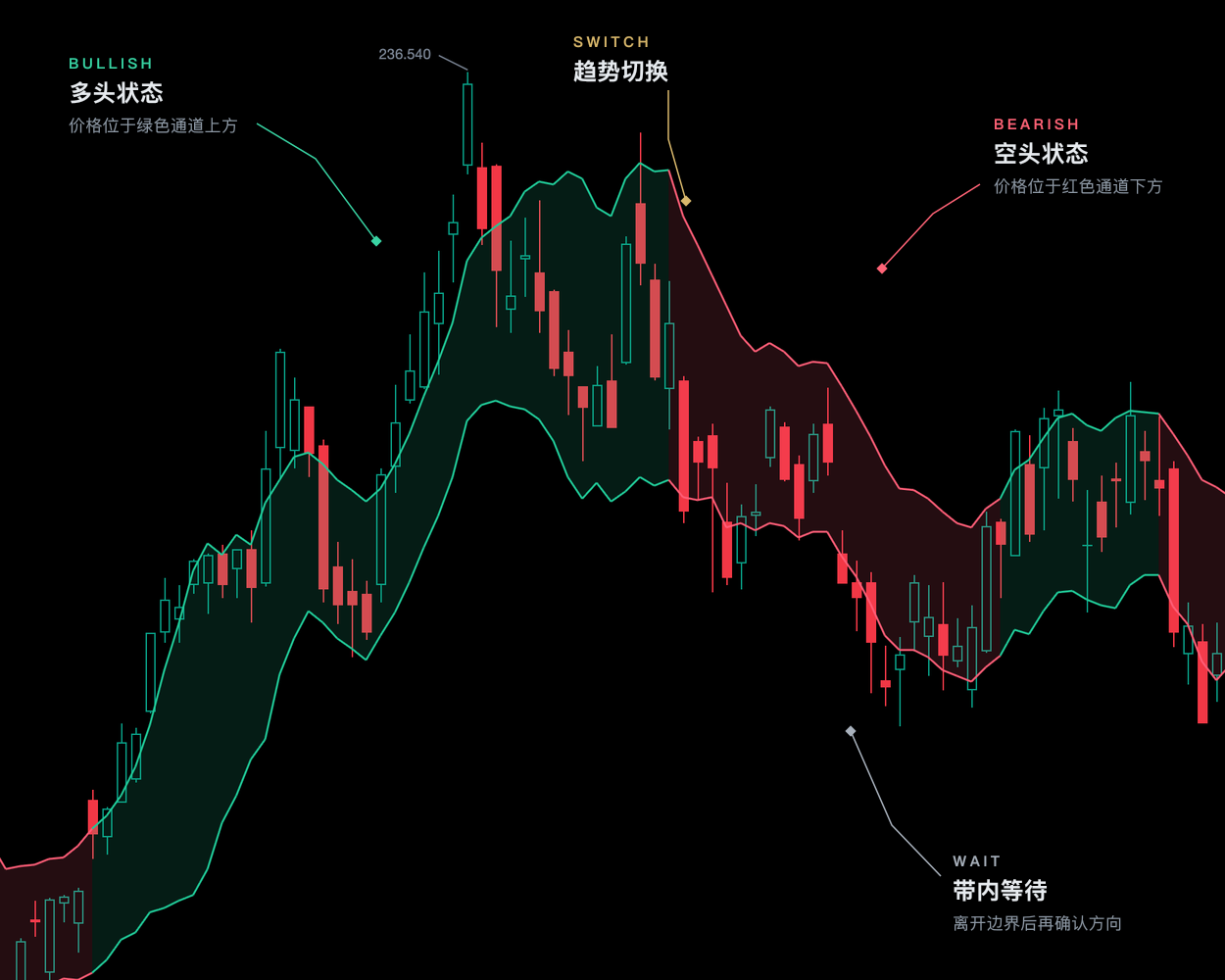
Use the Reactor to read trend direction and find cleaner pullback or rebound areas. A green channel favors long setups, while a red channel favors short setups. When price returns to the edge of the band, treat it as dynamic support or resistance to watch.
V2 is a high-length, displacement-adaptive low-lag channel that does not require volume. It keeps only green and red direction states and does not borrow the separate Quantum Reactor's gray state. The channel remains a clearly visible ribbon rather than a hairline. V1 remains available for saved charts with its multi-filter and Range ADX initialization behavior. Avoid chasing when price is far from the channel; a wider channel usually means volatility is expanding.
How to read the chart
- Green Reactor band
- Bullish state above the band; its edge can act as pullback support
- Red Reactor band
- Bearish state below the band; its edge can act as rally resistance
- Upper/lower edges
- The visual emphasizes band borders and fill without an extra center line
- Channel width
- Wider means more volatility or filter dispersion
Signal confirmation
Trend switch
A confirmed close changes from one side of the band to the other and recolors it
Retest confirmation
After a trend forms, price revisits the band edge and closes back with the trend
Further viewing
Watch on YouTubeThis video is for feature guidance only. Use the output and parameters shown on this page as the source of truth.
How to use it
- 01
Use channel color as a direction filter rather than a standalone entry
- 02
The first trend retest is usually easier to risk-manage than chasing a stretched price
- 03
While price is inside the band, wait for a boundary exit instead of treating every swing as a reversal
- 04
Avoid chasing far from the center where mean-reversion pressure is larger
The first bars after a major gap and prolonged directionless low-volatility markets.
Parameter guide
V2 is the displacement-adaptive low-lag channel; V1 preserves the historical multi-filter model
Higher is wider and stricter; lower is more responsive
V2 only; calibrated against the official visual with an unknown warmup state, while lower values react faster
V1 only; filters in-band initialization and never grays an established trend
Visual only; boundaries and trend state are unchanged
For technical-analysis education only, not investment advice. Use independent judgment and risk controls.